
Every year, businesses lose billions in revenue because customers slip away due to preventable, but often unnoticed reasons. And the worst part? Many of these customers want to stay.
If your business relies on recurring payments or subscriptions, passive churn could be the silent killer draining your growth potential.
In this blog, we’ll dive deep into what passive churn is, what causes it, and more importantly, how you can stop it in its tracks before it eats away at your business.
Passive churn—also known as involuntary churn— occurs when customers unintentionally stop using your service due to reasons beyond their control or awareness
Unlike voluntary churn, where customers actively cancel or leave, passive churn happens when technical or payment-related issues cause them to lose access to a service, despite wanting to stay. Common triggers for passive churn include expired credit cards, failed payments, or confusion about billing.
This unintentional loss of customers is harmful because these are people who still value your service and would likely continue if not for the preventable issue.
Passive churn is often a “silent killer” for businesses because it flies under the radar—customers don’t reach out, and you may not know they’re gone until the lost revenue starts piling up.
According to FlyCode co-founder Tzachi (TD) Davidovich:
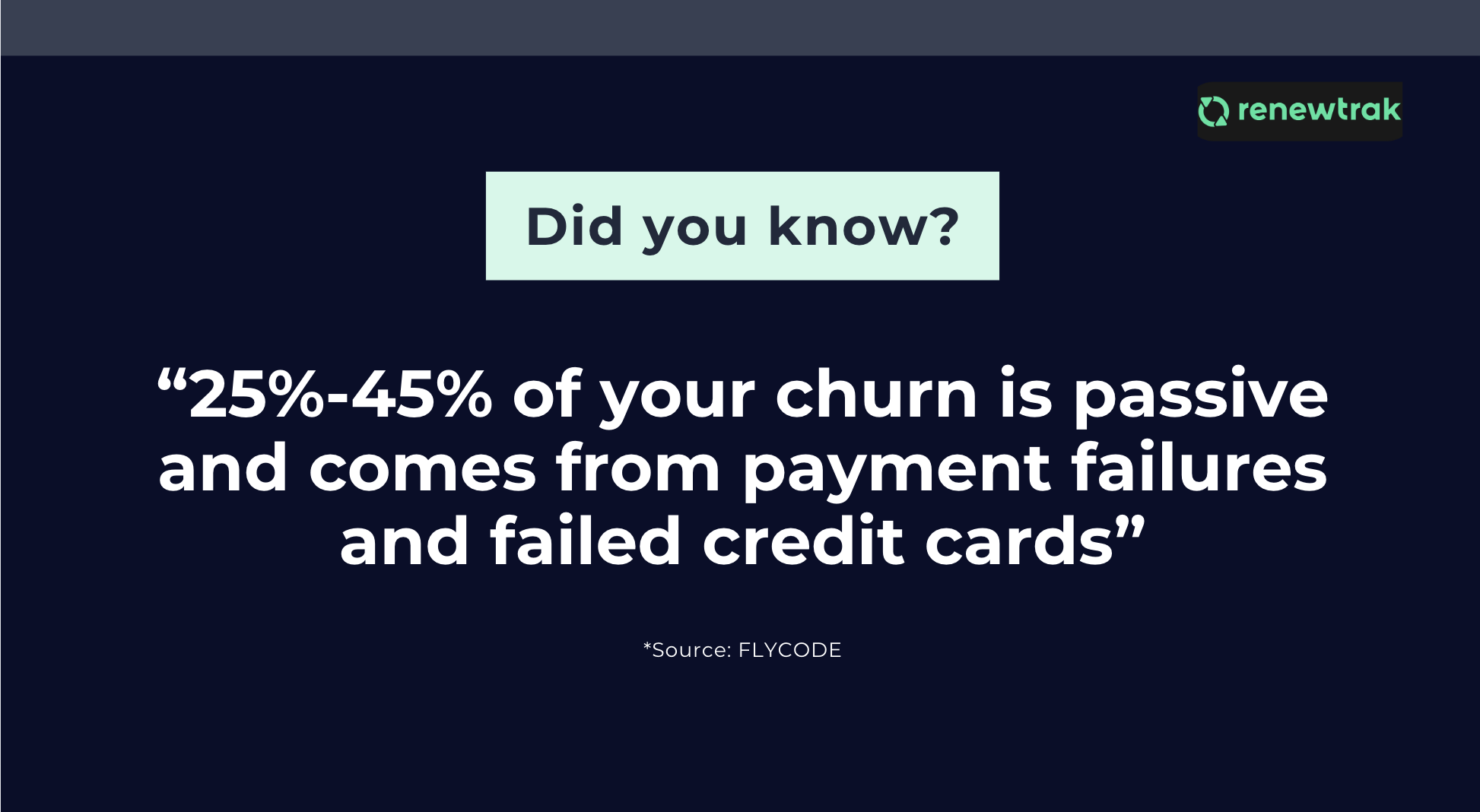
“25%-45% of your churn is absolutely unnecessary and comes from payment failures and failed credit cards. If your churn rate is 10%, then almost half can be recovered. You are losing money every day for no reason”
Several factors can contribute to passive churn, including:
Expired Payment Methods: Customers may forget to update their credit or debit card details after they expire, leading to failed payments.
Insufficient Funds: A customer may temporarily have insufficient funds, causing a payment failure. This is usually unintentional and can be resolved with multiple payment attempts.
Fraud Prevention Measures: Banks or payment processors may flag legitimate transactions as suspicious, resulting in rejected payments. Often, the customer isn’t aware of the rejection, which leads to unintentional churn.
Payment Processor or System Errors: Sometimes, technical issues with payment gateways or processors result in failed transactions, despite there being no issue with the customer’s payment method or funds.
Billing Confusion or Lack of Transparency: If customers don’t understand when their payment is due, or if the billing cycle isn’t clear, they may miss payments unintentionally.
Cross-border Payment Issues: International customers can experience payment issues due to currency conversions, additional fees, or restrictions that block certain transactions.
Manual Payment Methods: Customers who need to manually process payments, such as those using bank transfers, may forget to complete the payment, especially if reminders are inadequate.
Negative Communication Related to Payment Failures: If communication about a payment failure is poorly handled—such as being unclear, delayed, or overly aggressive—it can lead to frustration. A negative interaction during this critical moment may push customers away, even if the issue is easily resolvable.
Customer Reevaluation Triggered by Payment Issues: When a payment fails, it can prompt customers to reevaluate the service they’re paying for. If the payment issue brings attention to costs or triggers second thoughts about the value of the service, they may decide to stop using it altogether, leading to churn..
Passive churn may be a silent problem, but the solutions are proactive and can significantly reduce revenue loss. Here’s how:
Implement an automated renewal platform such that regularly reminds customers about upcoming renewals, payments, expiring credit cards, or payment issues. Regular notifications via email, SMS, or app notifications can help customers stay on top of their accounts, reducing the likelihood of failed transactions. At Renewtrak we recommend beginning the reminder as early as 120 days before their renewal date to minimize churn risk as much as possible.
Set up your payment system to automatically retry failed transactions multiple times. A failed payment could be due to temporary issues like insufficient funds, which may be resolved on the next retry. Providing several chances for payment to go through can capture revenue that would otherwise be lost.
Ensure you have multiple contacts from each client organization and include them on reminders. If one person misses a renewal reminder due to being on vacation, changing roles, or leaving the company, you can still reach out to other points of contact to avoid accidental cancellations. This approach also ensures that important subscription information reaches the right people, reducing the risk of passive churn caused by internal disruptions.
Give customers flexibility by offering a variety of payment methods, including credit cards, purchase orders and esign. The more payment options available, the less likely a customer will passively churn due to a single failed transaction.
Dunning refers to the process of communicating with customers about failed payments and overdue accounts. Specialized dunning management tools like Stripe Billing can automate this process, sending reminders, and retrying payments, while making it easy for customers to update their billing information.
Customers should have an easy, frictionless way to update their payment information. Provide a user-friendly interface that makes it simple to update expired cards or switch payment methods. The easier it is to manage accounts, the less likely passive churn will occur.
Sometimes, allowing a brief grace period after a failed payment can give customers enough time to resolve their payment issues without losing access to your service. This also shows customers that you value their loyalty and are willing to work with them during temporary setbacks.
Regularly track key churn metrics to identify trends in passive churn. This can help you spot the most common causes of payment failures and adjust your strategies accordingly. For instance, if you notice a pattern of customers churning due to expired credit cards, you can increase the frequency of card expiration reminders.
Many B2B businesses make the renewal process cumbersome, often requiring communication back and forth between teams to finalize billing, update contacts, or process payments. This complexity can increase the likelihood of passive churn when things fall through the cracks.
To reduce this, B2B companies should take a page from B2C companies, where checkout experiences are typically fast and easy. At Renewtrak, we have simplified the renewal process by allowing users to:
This streamlined, self-serve model minimizes friction, allowing customers to easily manage their renewals and payments without delays or confusion, drastically reducing passive churn risk.
At Renewtrak, we make renewals easier by automating the entire renewal process, ensuring that passive churn is minimized and efficiency is maximized.
Our platform sends automated reminders to keep your clients on top of their renewals, identifies renewal likelihood and risks, and provides a seamless ecommerce checkout experience.
With Renewtrak, your customers can manage renewals, update payment and personal information, and complete transactions all without any manual intervention—making the process as easy as possible.
All communications, renewal data and management are centralized in one place. This unified approach enhances efficiency, keeps your team aligned, and significantly reduces churn, saving you time and revenue.
Want to see whether Renewtrak is the right fit for your business? Get a demo today or sign up to get a access to our sandbox